Thirty-five years after the Capitol Crawl, people still discover accessibility like it’s breaking news.
“Nobody told me.”
I believe them.
And that’s the problem.
Think about every room where a decision that shaped your digital world was made.
The computer science lecture where you learned to build your first website. The human-computer interaction course where you studied user research, personas, and cognitive load. The web design curriculum where you mastered Figma, learned the grid, understood typography. Valuable rooms, all of them.
Was accessibility on the syllabus? Was a screen reader ever demonstrated? Did anyone mention that roughly one in five people has a disability – and that number climbs sharply as your users age?
Probably not. Because disability wasn’t on the curriculum. It still largely isn’t.
That’s the first room. And it matters, because everything that comes after – every career, every product decision, every “nobody told me” – starts there.
But it doesn’t stop there.
Think about the room where your company’s procurement checklist was written. The room where “good enough” got defined for your last product launch. The room where someone decided an overlay tool was sufficient, checked the compliance box, and moved on. The room where a digital strategy got signed off for an organization whose entire mission is to serve disabled people – and nobody in that room thought to test it with the people who needed them most.
These rooms exist everywhere. In government. In healthcare. In the third sector. In tech companies that pride themselves on user-centered design.
And in almost every one of them, the same people weren’t there.
“Talk less, smile more”
There’s a song in Hamilton that burned itself into my memory.
Aaron Burr has watched decisions get made – decisions that shaped history, that shifted power, that changed everything – and he wasn’t there. He didn’t get a seat. He didn’t get a vote. He got to find out afterward, like everyone else.
The song isn’t really about one dinner. It’s about all the rooms where decisions get made, and what it costs to spend your life outside them. The fury of watching consequences ripple out from decisions you had no voice in. The slow burn of a world that was shaped without you.
“Talk less, smile more” is Burr’s survival strategy. Be reasonable. Don’t make it uncomfortable. Work around it.
It destroys him.
Disabled people have been outside that room for decades. Not in the room where the product got specced. Not in the room where accessibility got cut from the sprint to hit the deadline. Not in the room where the university curriculum got approved without a single mention of assistive technology. Not in the room where the procurement team bought the overlay, called it compliance, and went to lunch. Not in the room where the laws were written. Not in the room where enforcement got funded – or didn’t. Not in the room where it was decided how those laws would be communicated to the people they were supposed to protect.
And like Burr, they’ve often been told that the reasonable thing – the polite thing – is to work around it. To be grateful for what exists. To talk less, smile more.
That strategy has a cost.
The people in the room don’t write the song. They don’t know there’s a song to write. The room felt normal to them because rooms always have.
The song comes from the people who were never let in.
Except sometimes, they do let you in.
They schedule meetings. They open comment periods. They invite testimony. The National Federation of the Blind had a meeting on May 6th to voice concerns about Section 504. The deadline in question takes effect May 11th.
There were meetings about the ADA Title II delay, too. Lots of them.
The outcomes were predetermined before anyone pulled up a chair.
That’s not inclusion. That’s the performance of inclusion. And there’s a crucial difference between being in the room and being invited in after the room is done with you.
The Vicious Circle
Here’s what prolonged exclusion from the room produces. When digital spaces are inaccessible, disabled people can’t participate in them. When they can’t participate, they’re not visible. When they’re not visible, they’re treated as outliers: rare edge cases, niche audiences, not the “real” user. And when they’re framed as outliers, there’s no business case, no urgency, no reason to prioritize them. So the spaces stay inaccessible.
Round and round.
This isn’t a technology problem. It’s not even really a legal problem, though we’ll get to that. It’s what happens when you build a world around the people already in the room, and then use the absence of everyone else as evidence that they don’t need to be there.
And it’s self-reinforcing. Every inaccessible website is a small act of erasure. Every form that can’t be completed with a keyboard, every video without captions, every godawful PDF – each one quietly confirms to the people who built it that disabled users aren’t really out there. Because if they were, surely someone would have said something.
Someone did say something. They just weren’t in the room.
Not on the syllabus
Think about how you learned to do what you do.
Somewhere in your education – a degree, a bootcamp, an online course, an internship – someone taught you the rules. How to write code that runs. How to design interfaces people can use. How to think about users: their goals, their frustrations, their mental models. The F reading pattern. Carousel blindness. Anchor pricing. Friction. How color changes how people feel.
Did anyone mention disabilities? Did anyone pull up Microsoft’s visualization of how impairments work – permanent, temporary, situational – and show you that designing for a one-handed user also helps someone holding a baby, or nursing a broken wrist?
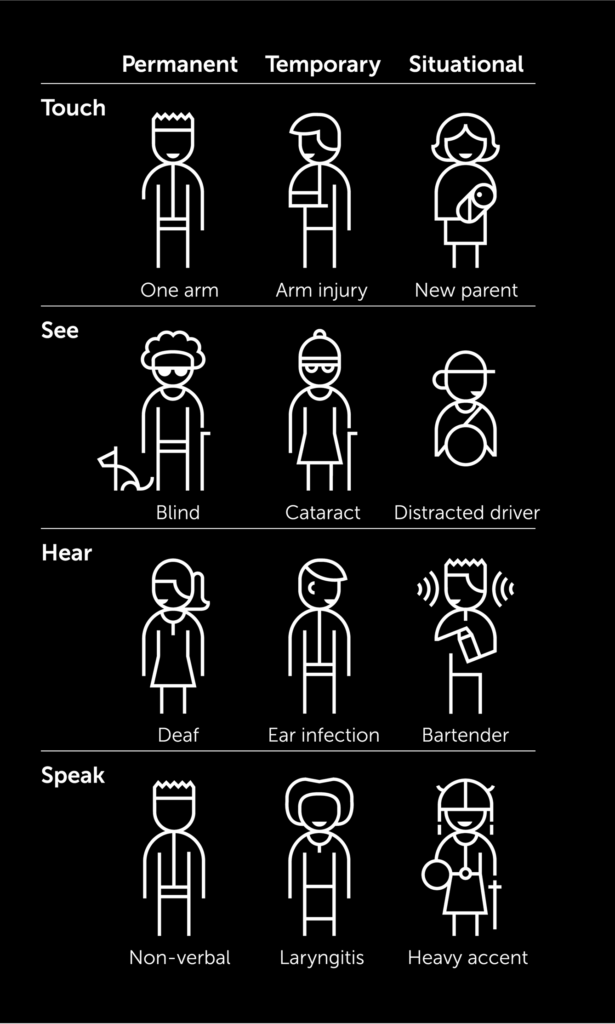
Probably not.
And so graduates enter the industry without ever encountering a screen reader. Never stopping to consider what happens to their beautifully designed dropdown when someone can’t use a mouse. They’re not indifferent. They’re just building in the same room they were taught in.
WebAIM noted a few years ago that the average age of an accessibility professional was over 40. The next generation isn’t being taught. Not systematically. Not as a baseline expectation of anyone who builds things people use.
And this matters beyond the practical. Education is one of the primary ways culture gets transmitted. It’s where we decide, collectively, what counts as essential knowledge. We teach children why curb cuts exist – or we don’t, and they grow up thinking sidewalks just look like that. We teach developers that accessibility is a requirement – or we don’t, and they ship inaccessible products and genuinely don’t understand why it’s a problem.
Law without culture
Here’s the thing about laws.
We know not to steal. Not primarily because theft is illegal, but because we grew up understanding that taking things that belong to other people is wrong. The law exists, sure. But the culture got there first.
We don’t need an enforcement mechanism to remind us that “Nigerian princes” don’t actually need our bank details. Awareness spread. People learned. The culture caught up.
Accessibility never got that foundation.
Instead, we got legislation. Good legislation, hard-fought legislation – people dragged themselves up 83 marble steps for it – but legislation dropped into a culture that had never been asked to think about disability. No education. No awareness campaigns. No moment where society collectively decided that excluding disabled people was wrong in the same bone-deep way that stealing is wrong.
Just a law. And a complaint process.
If you’re a disabled person in the US whose rights under the ADA have been violated, here’s your recourse: hire a lawyer, prove standing, demonstrate harm, survive a motion to dismiss, and wait. The enforcement mechanism for one of the most significant civil rights laws in American history is civil litigation. The burden lands entirely on the people who were already failed.
Please direct all complaints to that brick wall over there.

It’s not that the law is meaningless. It’s that law without a cultural foundation only works if someone’s willing to fight for it in court. And we made that the disabled person’s problem.
This is why the three cases for accessibility exist – the ethical case, the business case, the selfish case. Not as a celebration of how many great reasons there are to do the right thing. As an indictment of how hard we have to work to get people to care at all. In a world where disability wasn’t frightening, where the Just World Fallacy wasn’t quietly doing heavy lifting in every boardroom and procurement meeting, where people understood that accessible infrastructure benefits everyone – you wouldn’t need three cases. It would just be obvious.
We skipped the part where it becomes obvious. We went straight to legislation because we had to. And legislation without culture is just a law people find ways around until someone sues them.
We outsourced the moral framework to enforcement. And enforcement in the US means civil action, which means the burden falls on the people who were already harmed. Disabled people have to lawyer up to access their rights.
That’s not a system. That’s an insult with paperwork.
Nothing about us without us
I’m a militant optimist. I have to be.
Not because the situation isn’t bleak. But because I’ve seen what happens when someone finally gets it. When a designer squints and watches the text disappear. When someone closes their eyes, hits tab, and realizes they have no idea where they are on the page. When a developer uses a screen reader for the first time and goes quiet and says, “oh.”
That moment is real. It happens. And it matters.
The problem isn’t that people suck. The problem is that we’ve been trying to create that a-ha moment after the walls went up. After the curriculum was approved. After the product shipped. After the law passed into a culture that was never asked to internalize it.
Nothing about us without us isn’t a radical demand. It’s a minimum standard.
Put disabled people in the room. From the start. Every time.
That’s it. That’s the whole thing.